
Comparative Analysis: Choosing the Right AI Product Management Framework
Decision criteria for AI product managers

We've reached the halfway point in my 8-part series on AI product management frameworks. So far, we've examined traditional data science models, CRISP-DM, CRISP-ML, and CRISP-GEN AI. In this fifth installment, I'll conduct a comparative analysis to help you determine which framework is right for your specific AI products and organizational context.
Framework Selection: A Product Manager's Decision Matrix
The right framework depends primarily on three factors:
Product type: What kind of AI capability are you building?
Organizational maturity: What's your organization's experience with AI?
User needs: What user problems are you trying to solve?
Let's examine how each framework addresses different product scenarios.
Key Framework Differences from a Product Perspective
Before diving into selection criteria, let's clarify the fundamental differences between these frameworks from a product management lens.
Data Handling Approaches
The frameworks differ significantly in how they approach data, a critical consideration for product planning:
CRISP-DM focuses on structured data and traditional data preparation, making it suitable for analytics-focused products
CRISP-ML emphasizes feature engineering, data versioning, and dataset shifts, addressing the dynamic data needs of ML products
CRISP-GEN AI centers on unstructured data, fine-tuning datasets, and retrieval corpora for RAG systems, supporting generative capabilities
These differences affect how you plan data resources, set timelines, and manage stakeholder expectations around data needs.
User Interaction Models
Each framework assumes different user interaction patterns:
CRISP-DM typically involves passive consumption of insights or predictions
CRISP-ML often includes user interaction with predictions, potentially with feedback loops
CRISP-GEN AI frequently involves co-creative processes where users iterate with the system
Understanding these interaction models helps you design appropriate user experiences and set realistic expectations.
Evaluation Approaches
The frameworks employ distinct evaluation strategies:
CRISP-DM and CRISP-ML rely heavily on quantitative metrics like accuracy and precision
CRISP-GEN AI requires both quantitative and qualitative assessment, often with human evaluation
These evaluation differences impact how you measure success, report progress, and determine product readiness.
Deployment and Maintenance
Post-deployment activities also vary across frameworks:
CRISP-DM often involves relatively static deployments with scheduled updates
CRISP-ML emphasizes continuous monitoring and model retraining
CRISP-GEN AI focuses on prompt refinement and guardrail adjustments alongside model updates
These differences affect how you plan resources for post-launch activities and set expectations for ongoing maintenance among stakeholders.
Side-by-Side Comparison for Product Managers
Let's examine how specific product management responsibilities differ across frameworks:
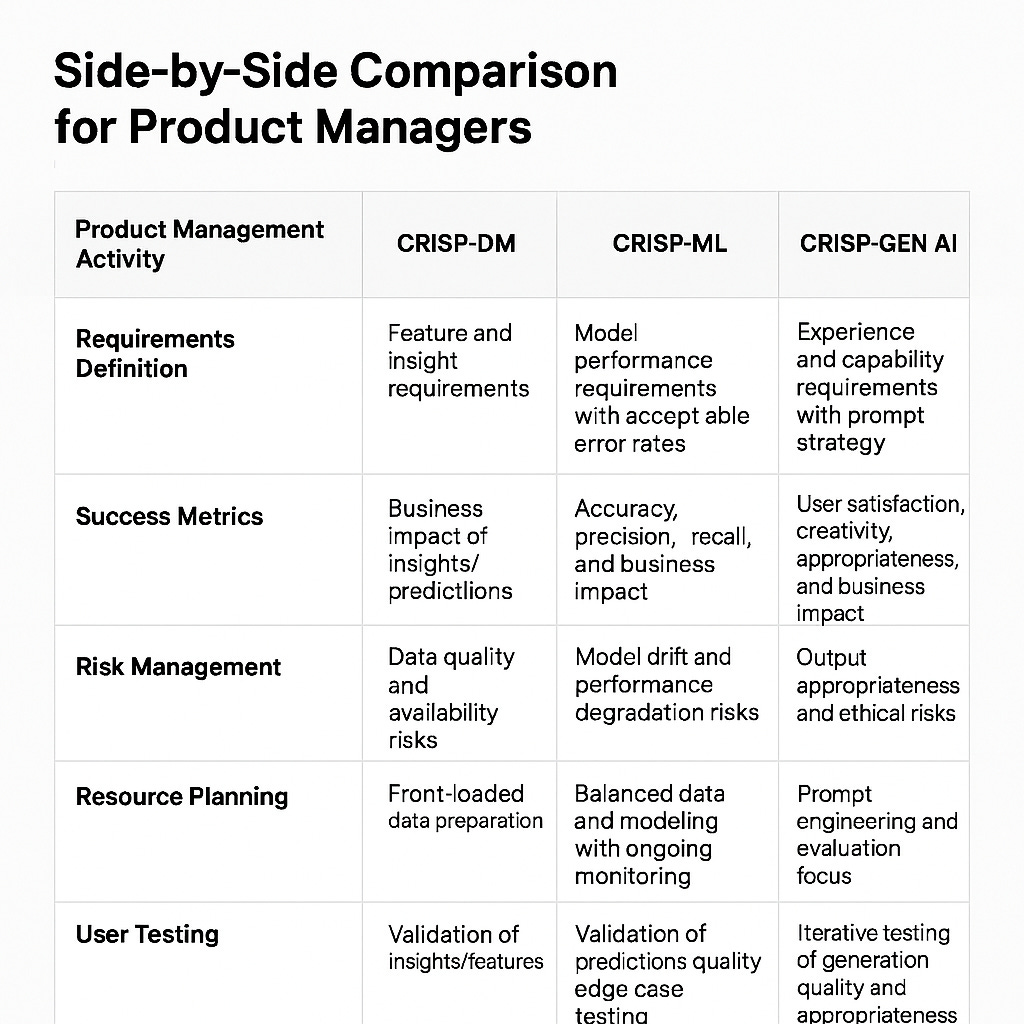
This comparison highlights how fundamentally different the product management approach can be across these AI paradigms.
When to Choose Each Framework: Decision Criteria
CRISP-DM Is Best For:
Analytics-driven products where the primary goal is to extract insights from existing data
Dashboard and reporting tools that transform data into visualizations or structured reports
Business intelligence applications with clearly defined metrics and KPIs
Early AI initiatives in organizations with limited AI experience
Products with stable data patterns that don't require frequent model updates
Product Manager Tip: Use CRISP-DM when your product delivers insights rather than predictions or generations, and when the path from data to value is relatively straightforward.
CRISP-ML Is Best For:
Predictive feature products that forecast future outcomes based on patterns
Classification systems that categorize items or detect patterns
Recommendation engines that personalize content or products
Computer vision applications for object detection or image classification
Products operating in dynamic environments where data patterns change over time
Product Manager Tip: Choose CRISP-ML when your product needs to make accurate predictions that directly impact user experiences, especially when those predictions need to remain accurate over time.
CRISP-GEN AI Is Best For:
Content generation tools that create text, images, or other media
Conversational interfaces like chatbots or virtual assistants
Creative assistance applications that help users with writing, design, or coding
Knowledge applications that synthesize information from large corpora
Products requiring human-AI collaboration, where users and AI work together
Product Manager Tip: Select CRISP-GEN AI when your product creates new content rather than just analyzing or predicting, especially when that content needs to be creative, contextually appropriate, and aligned with user intent.
Hybrid Approaches for Complex Products
Many modern AI products combine multiple AI capabilities, requiring hybrid framework approaches:
Example 1: Product with Analytics and Prediction
A financial planning application might use:
CRISP-DM for historical spending analysis features
CRISP-ML for future expense prediction features
Product Management Approach: Maintain separate tracking for each capability, with relevant success metrics and maintenance plans.
Example 2: Product with Prediction and Generation
A content marketing platform might use:
CRISP-ML for audience targeting features
CRISP-GEN AI for content creation features
Product Management Approach: Develop integrated user experiences while managing the underlying capabilities with different frameworks, recognizing their distinct development and maintenance needs.
Example 3: Comprehensive AI Suite
An enterprise AI platform might incorporate:
CRISP-DM for business intelligence features
CRISP-ML for predictive analytics features
CRISP-GEN AI for assistant and content generation features
Product Management Approach: Create a unified product experience layer while maintaining framework-specific processes for each capability type, with clear integration points.
Practical Implementation: A Product Manager's Workflow
How do you operationalize these frameworks in your day-to-day product management activities?
In Agile Environments
Integrate AI framework phases with agile ceremonies:
Use framework phases to structure epic planning
Incorporate phase-specific quality checks into the definition of done
Create specialized backlog items for framework-specific activities
In Product Requirements
Structure requirements documents to reflect the appropriate framework:
Include framework-specific sections (e.g., prompt strategy for CRISP-GEN AI)
Define success criteria aligned with the framework's evaluation approach
Specify maintenance requirements based on the framework's post-deployment focus
In Stakeholder Communication
Align stakeholder updates with framework terminology and expectations:
Educate stakeholders on the selected framework's approach
Set appropriate timeline expectations based on framework phases
Use framework-specific metrics in progress reports
Case Study: Framework Selection in Action
Let's examine how a fictional company, TechCorp, selected appropriate frameworks for different products:
Product A: Customer Churn Dashboard
Need: Identify customers at risk of churning and contributing factors
Framework Selected: CRISP-DM
Rationale: Focus on historical data analysis with clear business metrics
Product Management Approach: Emphasis on business alignment and insight actionability
Product B: Predictive Maintenance System
Need: Predict equipment failures before they occur
Framework Selected: CRISP-ML
Rationale: Required continuous monitoring and model updates as equipment conditions change
Product Management Approach: Focus on performance monitoring and update processes
Product C: Customer Support Assistant
Need: Generate contextually appropriate responses to customer inquiries
Framework Selected: CRISP-GEN AI
Rationale: Primarily generative with a need for prompt management and content appropriateness
Product Management Approach: Emphasis on prompt strategy and human evaluation
This case illustrates how a single organization may need to use different frameworks for different products, depending on the specific AI capabilities being developed.
Selecting the right framework isn't just a process decision; it's a strategic product choice that affects:
Resource allocation: Where you invest time and effort throughout the product lifecycle
Timeline expectations: How you structure development phases and set deadlines
Team composition: What skills and roles do you need at different stages
Risk management: What risks do you prioritize, and how do you mitigate them
Success measurement: How you define and track product success
As an AI product manager, your framework choice should reflect your product's specific AI paradigm, your organization's maturity, and your users' needs. By making this choice intentionally rather than defaulting to a one-size-fits-all approach, you set your product up for success from the beginning.
In my next post, I will build upon this comparative analysis to propose an enhanced framework that integrates the strengths of all three approaches, creating a flexible methodology that can adapt to different AI product types while maintaining consistency in its overall structure.
This is the fifth post in my series on "Enhancing CRISP-DM for Modern AI Product Management." Join me for the next installment, where I'll propose an enhanced framework that combines the best elements of CRISP-DM, CRISP-ML, and CRISP-GEN AI.